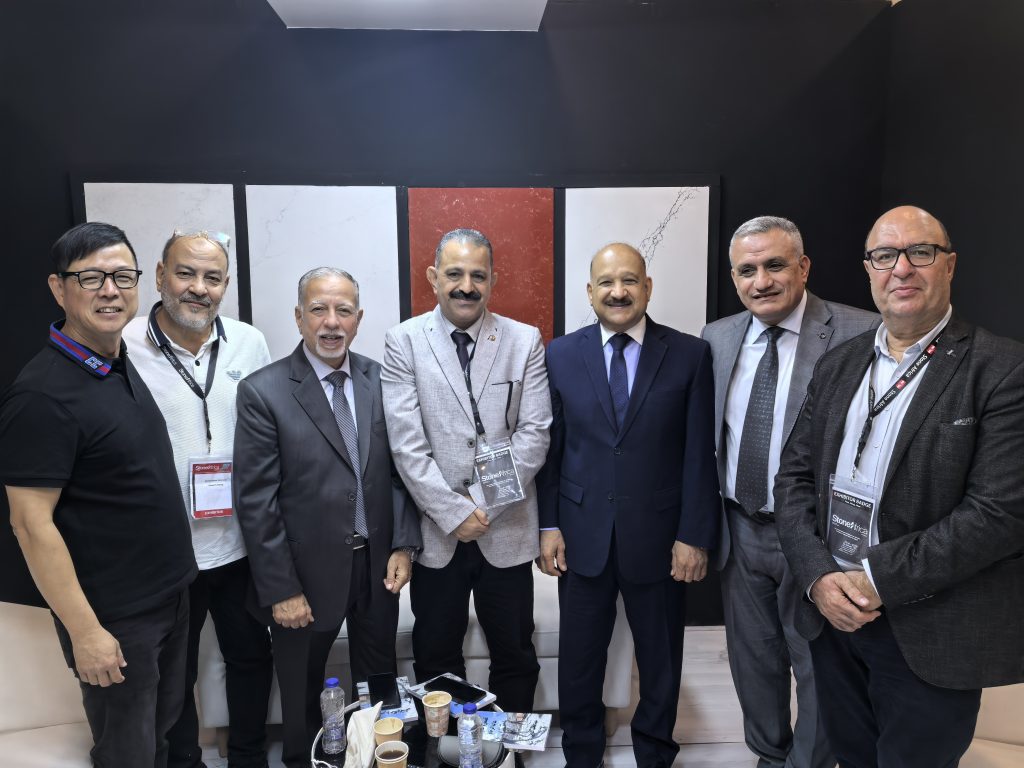
In the showroom, Mr. Lv Minghua introduces the stone products.
Profile
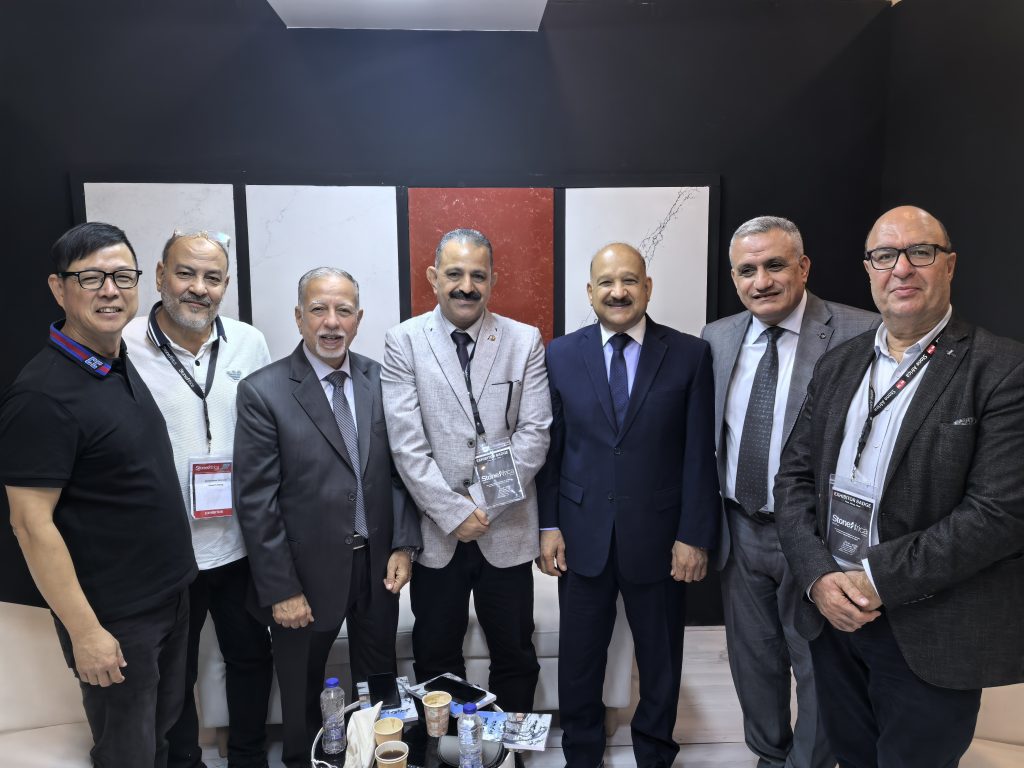
Lv Minghua is a native of Shuitou, Nan’an, Fujian Province. He currently serves as Chairman of the Board of Supervisors of the Fujian Association and Fujian Chamber of Commerce in Egypt, Secretary-General of the Egyptian Chinese Stone Association, and General Manager of Golden Nile Stone Industry Co., Ltd. (Egypt) and Fujian Nan’an Longjia Stone Industry Co., Ltd. (hereinafter referred to as “Longjia Stone”).
Witnessing and Leading a Golden Era of China–Egypt Stone Trade
Twenty years ago, when he first set foot on the land of Egypt—rich in exotic culture and commercial opportunities—Lv Minghua could hardly have imagined that he would personally witness and help lead a golden era of cooperation in the China–Egypt stone trade.
A young entrepreneur from Nan’an, Fujian, Lv Minghua arrived in Egypt without knowing Arabic or understanding the local market landscape. Yet driven by sharp market insight and boundless aspirations for the future, he firmly positioned himself on the “front line” of China–Egypt stone trade. From initial trading operations to establishing factories in Egypt, expanding into the local market, promoting the formation of overseas industry associations, and engaging in public welfare initiatives, his journey reflects both the spirit of a dream-chaser and the responsibility of a bridge builder. He has not only helped the stone industry gain a greater share of international markets, but also injected new momentum into economic and cultural exchanges between China and Egypt.
Text/Photos by Reporter Li Yangyu
From Exploring a Foreign Land to Building an Industry: Creating a China–Egypt Stone Corridor
Turning back the clock to the early 2000s, China’s domestic stone market was still limited in variety. Egypt, known for its high-quality beige marble, had already established itself as one of the world’s four major stone production bases, offering immense commercial potential. Lv Minghua’s uncle, Wang Zhenmao, keenly recognized this opportunity and traveled to Egypt in 2000 to explore the market. Under Wang’s guidance, Lv Minghua made a decisive career shift in 2004, entering the Egyptian stone industry and embarking on his entrepreneurial journey.
“Language, culture, policies, and market barriers came one after another when I first arrived,” Lv recalled. Faced with these challenges, he chose patience and perseverance. He proactively learned Arabic, studied local customs, and explored business practices, starting from the ground up. Over time, he accumulated deep market insight and built extensive networks.
“Egyptian workers are paid weekly and often spend their wages before returning to work,” Lv explained. “So we hired more workers and maintained sufficient manpower to ensure smooth production. As we gained a deeper understanding of the local market, the company expanded into other product categories, forming a diversified development model that combined exports with domestic sales.”
This practical adaptability and cultural sensitivity became key factors in his success in a foreign market.
In 2003, amid China’s booming real estate sector, Wang Zhenmao realized that pure trading alone would not ensure long-term competitiveness. He returned to Shuitou, Nan’an, to invest in factory construction, building a complete production chain from source to end-user and transforming the business from a trader into a manufacturer.
By 2005, China–Egypt trade reached a record high, with stone products accounting for nearly 30% of the total volume. Longjia Stone played a significant role during this period. At its peak, the company’s annual trade volume reached 2.5 million square meters—equivalent to 6,000 containers—establishing its leading position in the industry.
In 2011, Longjia Stone further extended its industrial chain by establishing two factories in Egypt, introducing advanced Chinese equipment and standardized production processes to improve local processing capabilities and export efficiency. That same year, Chinese enterprises accounted for 65% of Egypt’s stone market share, becoming the dominant force. From 2015 onward, Longjia Stone expanded beyond exports and entered the Egyptian domestic market, achieving dual growth in products and markets.
“Business is not a one-time deal—it’s about mutual benefit and long-term cooperation.” This principle, taught by his uncle, became a guiding light for Lv Minghua. As a middle link in the supply chain, he believed in protecting upstream quarry owners while ensuring downstream clients received the best value. Rather than engaging directly in quarry mining, Lv adopted a “financing + cooperation” model to build deep, mutually beneficial partnerships with Egyptian quarry owners.
“Stone is not just a building material—it is also a cultural carrier,” Lv said. “I want to explore diversified development paths, not just make more deals, but find direction through learning and value through culture.”
Today, Lv Minghua is participating in the filming of Twin Cities of the Maritime Silk Road, a documentary jointly produced by the Fujian Radio, Film and Television Group and Egypt’s National Television. The documentary portrays young entrepreneurs from both countries pursuing their dreams abroad. Lv’s 20-year journey between China and Egypt vividly illustrates the dynamic interaction of China–Egypt economic and cultural exchanges.
From Crisis Evacuation to Collective Self-Rescue: Building Overseas Chinese Industry Organizations
Entrepreneurship abroad was far from smooth. In 2011, an increase in Egypt’s mineral resource tax posed unprecedented challenges. Political turmoil followed, leading to deteriorating security conditions.
“At that time, tanks filled the streets. Gunfire at night, shelling during the day,” Lv recalled. He and 60–70 fellow townsmen were trapped without electricity, internet, or communication. After 36 hours, they finally contacted the Chinese Embassy. Though the airport was only 30 kilometers away, the journey was fraught with danger. Guided by locals, they passed multiple checkpoints and eventually reached safety. During the evacuation, Lv and fellow Nan’an natives took the lead, prioritizing the elderly, women, and children, followed by compatriots from Hong Kong, Macao, and Taiwan—demonstrating unity and mutual support among the Chinese community.
After evacuation, Lv closely monitored the situation and returned once stability gradually resumed. Realizing that individual efforts were insufficient to withstand external risks, he promoted collective action. In 2012, he co-founded the Egyptian Chinese Stone Association and served as its first Secretary-General. It became the first Chinese industry association in Egypt, bringing together 126 Chinese-funded enterprises and serving as a key platform for development and mutual protection.
“Doing business abroad also means taking on social responsibility.” Under the association’s leadership, Lv and his peers actively participated in local public welfare initiatives. During Ramadan, they organized free meal distributions for local residents, earning high praise from the Chinese Embassy in Egypt. The embassy later encouraged all Chinese chambers and associations in Egypt to jointly organize month-long Ramadan charity activities.
As China–Egypt exchanges deepened, Lv recognized the need for a more formal organization to unite Fujian natives in Egypt. In 2017, under official guidance, he participated in the establishment of the Fujian Chamber of Commerce in Egypt. By December 25, 2024, the chamber was officially inaugurated, with over 100 members and more than 60 enterprises, forming a united and mutually supportive Fujian business community.
Reporter’s Notes: Telling China’s Story on the World Stage
From a pioneer exploring foreign markets to a founder of industry associations and a promoter of brand innovation, Lv Minghua has forged a representative “Nan’an path.” Using stone as a medium, he built bridges between China and Egypt; with responsibility as his foundation, he created a safety network for overseas Chinese; and with culture as his soul, he elevated stone products from construction materials to aesthetic expressions.
His journey shows that the true value of an entrepreneur lies not only in profit, but in resilience, adaptability, and a global vision. Moving forward, Lv Minghua will continue to stand at the forefront of his time—writing with stone, guided by conviction—the strength and integrity of Chinese entrepreneurs.